
Potato Cyst Nematode: the hidden soil threat to Europe’s potato crops
Dr James Price, The James Hutton Institute
Solanaceous crops, including potatoes, tomatoes and aubergines, are among the world’s most widely cultivated crop species, providing food security and nutrition to billions of people worldwide. However, increased global production of solanaceous crops has also increased the availability of these plants as a source of nutrition for many plant pathogens.
Potato cyst nematodes (PCN) are parasitic roundworms that have evolved and spread alongside the domestication of solanaceous crops. In Europe, there are two main species of PCN of agricultural importance, Globodera rostochiensis and Globodera pallida. While PCN can infect many different solanaceous hosts, they are primarily and economically most important as parasites of potato.
Inside the PCN life cycle
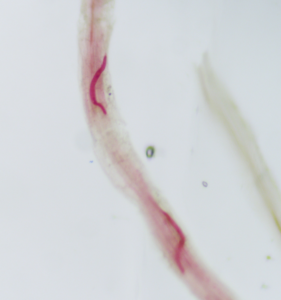
Like all nematodes, PCN juveniles hatch from eggs. Unlike many other nematodes, this hatching is tightly regulated, occurring only in the presence of chemicals originating from the roots of a host plant. This signals to the otherwise dormant juveniles that a suitable host is nearby. After hatching, the juveniles use these same chemical signals to locate host roots. The juveniles enter the root and migrate through the host tissue, locating a feeding site. Using a probing, needle-like stylet (a hollow, spear-like mouthpart), the nematode begins modifying the host, restructuring plant cells to form a syncytium, a single feeding site made from merged plant cells. Up to this point, the nematodes are not sexually differentiated.
If feeding is successful, the nematodes will develop into females. Their muscles undergo atrophy and they remain at this single feeding site for the rest of their life. If feeding is unsuccessful, the juvenile develops into a male, exits the plant, and never feeds again. The females continue to feed from the syncytium, their bodies begin to swell, and eggs start to form within the body. The female diverts nutrients from the host to support egg production. For the host plant, this results in yellowing leaves, stunted growth and severely reduced tuber formation.
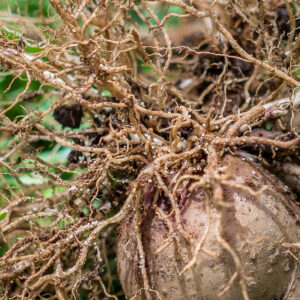
Eventually, the posterior end of the female nematode ruptures through the host root and becomes exposed to the surrounding soil. Males are then able to mate with the female, fertilising the eggs. As the female ages, her body begins to harden, forming a cyst that can contain ~500 eggs. The cysts detach from the roots and remain in the soil, where the next generation of juveniles enters a prolonged dormancy period, anticipating the absence of a suitable host crop until a future growing season. As in the previous generation, this dormancy is broken only when host-derived chemical signals are detected, and the lifecycle begins again. This lifecycle takes around 10–14 weeks and in cool climates typically only 1 generation is produced per growing season.
How PCN reached Europe
PCN originate from South America, where they share a close evolutionary relationship with potatoes, which were domesticated in the same region. Early PCN infestations were likely introduced into Europe when potato breeding material was imported to combat late blight epidemics in the mid-19th century during which dormant cysts were inadvertently transported in contaminated soil adhering to plant material. There have likely been several subsequent introductions of PCN into Europe, which then acted as a secondary distribution centre, facilitating spread to most major potato-growing regions worldwide.
Key terms in this article
Resistance
The ability of a potato variety to stop or greatly reduce nematode reproduction. Resistant plants trigger a defence response that prevents the pest completing its life cycle: they can still be infected, but far fewer nematodes survive to reproduce, so cyst numbers in the soil reduce over time.
Tolerance
The ability of a potato plant to keep producing a good yield even when nematode numbers in the soil are high. Tolerant varieties don’t reduce the pest population, they simply keep growing well despite it. Resistance and tolerance are separate traits: a variety can have one without the other.
Infestation/infection pressure
The size of the nematode population already present in the soil, meaning the number of eggs and juveniles that could attack a crop. High infestation pressure means a large existing population, which raises the risk of yield damage regardless of a variety’s resistance or tolerance.
Cyst
The hardened body of a dead female nematode, left behind in the soil, that acts as a package of ~500 dormant eggs. These eggs remain viable in the soil for up to 20 years, waiting for a host plant to trigger hatching.
A2 quarantine pest
An EU regulatory classification for pests that are not widely established, or are only found in limited areas, but are considered serious enough that member states are legally required to act to prevent their introduction and further spread.
Pathotype
A group within a nematode species defined not by appearance, but by which potato resistance genes it can overcome. Two nematodes of the same species can belong to different pathotypes if they differ in which resistant varieties they’re able to infect successfully.
Nematicide
A chemical product used to suppress plant-parasitic nematodes. Most nematicides work against hatched, active juveniles moving through the soil; they don’t reach juveniles still in eggs, so the cysts’ egg reservoir survives to threaten future crops.
Why PCN is so hard to control
PCN management is extremely challenging as eggs can remain dormant in the soil for up to 20 years. Over their lifecycle, PCN are largely immobile. As with their initial introduction to Europe, almost all new infestations rely on the movement of dormant cysts into previously uninfected areas. Preventing the introduction of contaminated soil remains the most effective management strategy for controlling PCN. However, given their microscopic size, it is impossible to determine visually whether cysts are present on or around seed potatoes. In Europe, PCN are listed as A2 quarantine pests, and national plant protection organisations enforce strict phytosanitary measures (biosecurity rules covering plant health) to limit their spread.
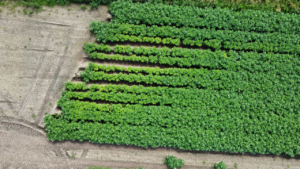
There is an economic knock-on effect here. Under the UK’s Seed Potato Classification Scheme, land must test free of PCN before seed potatoes can be planted there, for certification or for a farmer’s own saved seed. Once a field tests positive, it is recorded as infested and removed from seed production; ware potatoes can still be grown there, but only under an approved control programme aimed at suppressing the pest. Because biosecurity measures slow spread rather than prevent it entirely, the area of infested land keeps growing: G. pallida-infested land in Scotland has been doubling roughly every 7 to 8 years, and recent estimates put PCN present on over a third of Scotland’s potato-growing land. For seed growers and landowners, this means a shrinking pool of land that still qualifies for seed production and can be rented out. It is therefore in everyone’s interest to manage PCN.
Current management options: resistance and nematicides
The most effective long-term control strategy is the use of naturally resistant potato varieties, which prevent successful nematode feeding and subsequent sexual development. The first major resistance gene, H1, was characterised phenotypically in 1952 using resources from the Commonwealth potato collection, still held by one of the CROPSAFE project partners (the James Hutton Institute, JHI).This resistance gene has been deployed commercially since 1966 and is present in over 40% of internationally important cultivars. There are now resistance genes available in commercial varieties against both major PCN species. However, resistance genes are often species- or pathotype-specific and do not always provide complete protection. In addition, not all resistant varieties are accessible to all growers due to breeding contracts and end-use requirements. There are, for instance, very few salad potato varieties that possess PCN resistance traits. Furthermore, resistance does not necessarily equate to tolerance, meaning that yield can still be severely affected under high PCN infestation pressure.
Where host resistance is not suitable or available, alternative management practices have relied on the use of chemical nematicides. The availability of these products varies greatly between countries. Currently available chemical nematicides target nematodes that have already hatched and are active in the soil, reducing infection pressure during the growing season and helping to protect crop yield. However, they cannot reach juveniles that are still within eggs. That egg reservoir stays viable in the soil, meaning cyst populations, and the risk they pose to future crops, are not significantly reduced by nematicide treatment alone.
CROPSAFE’s approach to PCN
This is where CROPSAFE comes in. Within the project, the James Hutton Institute, in Scotland, is leading work on potato protection strategies using bio-sourced materials. The approach centres on extracting biologically active compounds from agricultural, forestry and marine by-products, materials that might otherwise go to waste, and developing them into effective, nature-derived pest control products.
JHI’s role within CROPSAFE is to understand how these compounds affect PCN biologically and to integrate the most promising candidates into practical, sustainable crop protection strategies. The goal is not just to control a pest, but to help move agriculture towards systems that are safer for people, kinder to the environment and less dependent on synthetic chemistry.
Read more about CROPSAFE’s work on nature-based crop protection, or get in touch to find out how the project could support your own PCN management strategy.